Affichage des articles dont le libellé est RUNNING. Afficher tous les articles

dimanche, mai 10, 2026

Marathon de Saumur


Après 4heures et 9 minutes d'effort
  • 4 heures et 9 minutes au marathon de Saumur : bon temps mais pas suffisant pour se qualifier pour Boston. 
  • Sens de l'effort maximal : c'est le premier marathon où je ne me suis pas arrété une seule fois : c'est une vraie Murakani 42,195 ! Non, même sans qualification pour Boston, c'est un bon temps et une belle course. 
  • Une course où j'ai progressé. 5 gels absorbés. 
  • L'allure est passée à 6 minutes et 11 secondes dès le 30 ème kilomètre. 
  • Courir kilomètre après kilomètre est la bonne approche, ne pas calculer en combien de temps je pourrais finir n'est pas la bonne approche.


lundi, mars 09, 2026

Marathon de Tokyo


Au retour du marathon de Tokyo avec la médaille
  • Excellente organisation du marathon. Les routes sont parfaites. L'accueil en fin de marathon par les bénévoles est unique.
  • Le marathon part de Shinjuku, passe par le temple de Asakusa, Tokyo Tower, puis Akihabara, Nihonbashi et finit vers la gare de Tokyo située près du palais impérial.
  • Le temps est mon pire temps. A croire que que les marathons majors ne me réussissent pas : 4h51. Comme quoi même avec un entrainement important, cela ne fait pas la différence.
    • Berlin : 4h36
    • New York : 4h06
    • Chicago : 4h45
    • Londres : 4h43
    • Tokyo : 4h51
  • Le point positif, j'ai fait une Murakani 35. A partir du 35ème, c'était dans la tête "je peux finir en marchant".
  • Les jambes un peu dur, mais pas aussi dures que par le passé.
  • Le temps au kilomètre est passé de 6 minutes jusqu'au 25 ème km, puis 6'30" à 7'40" du 26ème au 35ème, puis 9'20" entre le 36ème et le 40ème, puis 8'30" sur les deux derniers kilomètres.
  • A partir du 36ème, je cherchais à faire diminuer la fréquence cardiaque pour reprendre des forces.
  • Après le passage de la ligne d'arrivée, je n'ai pas levé les bras.
  • J'ai fini les deux derniers kilomètres en savourant le fait d'avoir la chance d'être ici. J'ai terminé les deux derniers kilomètres en courant.
  • Un membre du groupe qui a eu les six étoiles a une VMA de 18 km/h.
  • Les pré-engagements ont fonctionnés et même au-delà : j'ai fait une Murakani 35.
  • Rang 19160 sur 38437. Pas de classement par catégorie d'age. 1200 coureurs n'ont pas terminés ou n'ont pas finis dans les temps.

jeudi, mai 01, 2025

Marathon de Londres 2025 - Le 24 ème marathon

  •  Quel beau temps nous avons eu pour ce 24 ème marathon, avec 21 degrés, un peu trop chaud pour courir. La prochaine fois, il faudra penser à la casquette. J'ai profité des jets d'eau qui arrosaient les coureurs et de ce fait je me suis retrouvé avec un mal de gorge le mardi suivant le marathon. La semaine suivante j'étais encore malade. Après le coup de blues subit après le marathon de Chicago, ça fait deux marathons de suite ou l'après course n'est pas sans conséquences.
  • Compte tenu du faible entrainement dû au Covid, je suis parti sur une allure de 6 minutes au km et j'ai fait une "Murakani 28" soit aucun arrêt avant le 28 ème km. Encore une fois, lors du prochain marathon, il faudra que j'augmente les kms lors des entrainements.
  • Il y a trop de coureurs qui marchent et c'est décourageant.
  • Mais vraiment très content de finir ce marathon en 4:41.
Tower Bridge (après 2 heures de course)

Sur le Mall avec Buckingham en fond

Dans les 195 derniers mètres

La joie immense de finir un marathon

La médaille


mardi, décembre 31, 2024

What I talk about when I talk about running - Murakami


Foreword Suffering is optional 

  • dodge: esquive
  • treatise: traité
  • shave: rasage
  • stray off: s'éloigner
  • painstaking: pointilleux
  • grueling: éreintant
  • dubbed: surnommer
  • Une personne qui a besoin d'écrire pour se comprendre.
  • Pain is inevitable. Suffering is optional.
  • The hurt part is an unavoidable reality, but whether or not you can stand any more is up to the runner himself. This pretty much sums up the most important aspect of marathon running.

One Who's Going to Laugh at Mick Jagger?

  • muggy: étouffant
  • lounging: se relaxer
  • inlet: crique
  • tack: approche
  • whisked: fouetter
  • scorching: brûlant
  • abstruse: abscon
  • speck: petite tâche
  • slumped: avachi
  • outwardly: extérieurement
  • farsighted: hypermétrope
  • waterfowl: gibier d'eau
  • floes: banquises
  • crisp: craquant
  • whizzing: mouvement à toute allure
  • kink: bizarrerie 
  • flab: graisse superflue
  • despised: méprisé
  • to brag: se vanter
  • to groan: grogner
  • to scream: hurler
  • void: vide
  • During the mornings, when it's cool, I sit at my desk, writing all sorts of things.
  • To keep on going, you have to keep up the rhythm. This is important thing for long-term projects.
  • Over this period, I've jogged almost every day, run at least one marathon every year - twenty-three up till now.
  • Running without a break for more than two decades has also made me stronger, both physically and emotionally.
  • I am the kind of person who doesn't find it painful to be alone. I find spending an hour or two every day alone, not speaking to anyone, as well as four or five hours alone at my desk, to be neither difficult nor boring.
  • Maintaining my own silent, private time, is important to help me keep my mental well-being.
  • And one of the results of running a little farther than usual is that I become that much stronger.

Two Tips on Becoming a Running Novelist

  • a breather: une pause
  • stocky: trapu
  • wicked: méchant
  • wee: pipi
  • spurt: giclée
  • reeked: empesté
  • slacker: fainéant
  • to stint: lésiner
  • to dredge: déterrer
  • to slough it off: se débarrasser
  • belated: tardif
  • qualms: scrupules
  • Since failure was not an option, I'd have to give everything I had.
  • Because I was always tired and felt like I was competing against the clock as I wrote, I was never able to concentrate.
  • I'am the kind of person who has to totally commit to whatever I do.
  • I could go to bed early and get up early.
  • The most important things can't be learned at school.
  • "Does a runner at your level ever feel like you'd rather not run today, like you don't want to run and would rather just sleep in?" He stared me and then, in a voice that made it abundantly clear how stupid he thought the question was, replied, "Of course. All the time!"
  • When we lace up our running shoes early in the morning we feel exactly the same way.
  • You're able to make a living as a novelist, working at home, setting your own hours, so you don't have to commute on a packed train or site through meetings. Don't you realize how fortunate you are? Compared to that, running an hour around the neighborhood is nothing, right?
  • Just as with school, you enter it, learn something, and then it's time to leave.
  • You can't please everybody.
  • I began to eat mostly vegetables, with fish as my main source of protein.

Three Athens in Midsummer - Running 26.2 Miles for the First Time

  • to stave off: éviter
  • to rack up: accumuler
  • hobbling down: boitiller
  • hindsight: recul
  • admonish: réprimander
  • jitters: frousse
  • baffle: déconcerter
  • squeaky: grinçant
  • to outrun: distancer
  • to whiz: siffler
  • stray: errant
  • dreary: morne
  • bead: perle
  • anchovy: anchois
  • scent: odeur
  • barren: stérile
  • shutter: obturateur
  • grate: grincer
  • blazing: embrasé
  • utter: absolu
  • grueling: exténuant
  • spigot: robinet
  • to snip off: découper
  • ghastly: épouvantable

  • I was basically trying to rack up the distance, not worrying about anything, but steadily increasing my pace and running as hard as I could.
  • Doing it gradually is important so you don't burn ut.
  • The point is to reach the peak of exhaustion about a month before.
  • I have to listen very carefully to the feedback from my body.
  • I'd made it a point of pride that no matter how hard things might get, I never walked.
  • There are three reasons I failed. Not enough training. Not enough training. And not enough training.
  • Train meticulously and rediscover what I was physically capable of. Tighten up all the loose screws, one by one.
  • Best to learn from my mistakes and put that lesson into practice the next time around.
  • I am writing, in other words, to put my thoughts in some kind of orders.
  • Up to nineteen miles I am sure I can run a good time, but past twenty-two miles I run out of fuel and start to get upset at everything. And at the end, I feel like a car that's run out of gas. But after I finish and some time has passed, I forgot all the pain and misery and am already planning how I can run an even better time in the next race. The funny thing is, no matter how much experience I have under my belt, no matter how old I get, it's all just a repeat of what came before.

Four Most of What I Know About Writing Fiction I learned by Running Every Day

  • sweltering: étouffant
  • I am following one of the basic rules for training: I never take two days in a row.
  • Running everyday is a kind of lifeline for me.
  • Focus: the ability to concentrate all your limited talents on whatever's critical at the moment.
  • I generally concentrate on work for three or four hours every morning.
  • As you age you learn to be happy with what you have. That's one of the few good points of growing older.

Five Even If I Had a Long Ponytail Back Then

  • cursing: jurer
  • glittering: brillant
  • acorn: gland
  • industrious: travailleur
  • barren: stérile
  • geese: oies
  • honed: aiguisé
  • hatchet: hachette
  • faithfully: fidèlement
  • notch: encoche
  • slush: neige fondue
  • thaw: dégel
  • a tank top: débardeur
  • tapering off: diminuer
  • brimming: déborder
  • to brag: se vanter
  • brash: impertinent
  • contrived: forcé
  • trite: banal
  • teeming: grouillant
  • plump: bruit sourd
  • filthy: sale
  • to belt out: beugler
  • Seeing a lot of water like every day is probably an important thing for human beings
  • I am aware of myself as one tiny piece in the gigantic mosaic of nature. I'm just a replaceable natural phenomenon, like the water in the river that flows under the bridge toward the sea.
  • There are plenty of things in this world that are way beyond me, plenty of opponents I can never beat.
  • But you need a great deal of energy to create an immune system and maintain it over a long period.
  • But, frankly, if I want to write a large scale work, increasing my strength and stamina is a must, and I believe this is something worth doing.
  • An unhealthy soul requires a healthy body.
  • Running is a great activity to do while memorizing a speech.

Six Nobody Pounded the Table Anymore, Nobody Threw Their Cups

  • whimsical: fantaisiste
  • to swell up: enfler
  • excruciating: atroce
  • bolt: vis
  • cog: roue dentée
  • to grit: sabler
  • plum: prune
  • sour: acide
  • seething: bouillonnant 
  • pound: frapper
  • to waft: flotter
  • ragged: irrégulier
  • trudging: marcher péniblement
  • bellow: beuglement
  • fleeting: fugace
  • ankle: cheville
  • wobbly: branlant
  • fallout: conséquence
  • halfhearted: peu enthousiaste 
  • ratcheted: baisser
  • notch: cran
  • to stir: mélanger
  • to grope: chercher à tâtons 
  • No matter how slow I might run, I wasn't about to walk. Break one of my rules once, and I'm bound to break many more.
  • Still, the most significant fallout from running the ultramarathon wasn't physical but mental. What I ended up with was a sense of lethargy, and before I knew it, I felt covered by a thin film, something I've since dubbed runner's blues.
  • Each time I ran a full marathon, my time went steadily down.
  • Maybe the only thing we can do is accept it, without really knowing what's going on.
  • Competing against time isn't important. What's going to be much more meaningful to me now is how much I can enjoy myself, whether I can finish twenty six miles with a feeling of contentment.
  • I'm nothing more or less than a professional writer who knows his limits, who wants to hold on his abilities and vitality for as long as possible.

Seven Autumn in New York

  • Reaching the finish line, never walking, and enjoying the race. These three, in this order, are my goals.
  • All I have to go on are experience and instinct. Experience has taught me this: You've done everything you needed to do, and there is no sense in rehashing it. All you can do is wait for the race. And what instinct has taught me is this one thing only: Use your imagination.

Eight 18 Till I Die

  • It always feels wonderful to finish a marathon - it's a beautiful achievement - but I wasn't satisfied with the time.
  • As long as my body allows, I'll keep on running. Even if my time gets worse.
  • I've always done what I felt like doing in life.

Nine At Least He Never Walked

  • Learning from experience is what makes the triathlon so much fun.
  • If pain weren't involved, who in the world would ever go to the trouble of taking part in sports like the triathlon or the marathon, which demand such an investment of time and energy? Its precisely because of the pain, precisely because we want to overcome that pain, that we can get the feeling, through this process, of really being alive - or at least a partial sense of it.
  • What's most important is what you can't see but can feel in your heart. To be able to grasp something of value, sometimes you have to perform seemingly inefficient acts.
  • Focusing on each stride forward, but at the same time taking a long-range view, scanning the scenery as far ahead as I can. I am, after all, a long-distance runner.
  • For a runner like me, what's really important is reaching the goal I set to myself.

Afterword On Roads All Round the World

  • What's on my mind right now?
  • But for me, there was the hope that writing this book would allow me to discover my own personal standard. 
  • For me, the main goal of exercising is to maintain, and improve, my physical condition in order to keep on writing novels.
  • Meanwhile, running for a quarter century makes for a lot of good memories.

vendredi, novembre 15, 2024

Hoka Clifton 9 Orange

  •  Pour remplacer mes chaussures de course  ON running qui ne m'ont pas convaincues, j'ai de nouveau acheté des Hoka Clifton 9 couleur Orange :


  • Taille : 44 2/3
  • Poids : 238g
  • Drop : 5 mm
  • Première sortie aujourd'hui avec les semelles orthopédiques de juillet 2024. On verra si le mal aux cervicales réapparait.

mardi, octobre 22, 2024

Marathon de Chicago

  •  Un marathon major de plus accompli avec Chicago, c'est le principal. Ce fut aussi le plus dur avec un temps final de 4:44.


  • Une défaillance à partir du 20 ème km que j'explique par le fait de ne pas avoir pu vider mes intestins. J'ai énormément bu (trop) et me suis arrosé avec de nombreux verre d'eau. J'ai fini tout au courage en me disant que j'ai pas fait tous les efforts pour venir à ce marathon et abandonner.


lundi, octobre 07, 2024

23 ème marathon - Entrainement pour le marathon de Chicago

  • 800 km d'entrainement en 4 mois (19 semaines)  et 56 séances pour le marathon de Chicago.
  • 10 sorties vélo pour un total de 678 km
  • Une interruption de 4 semaines suite à des douleurs cervicales.
  • L'objectif pour le marathon est de faire mieux que le précédent (4h10)
  • Passage espéré en 1 heure 53 minutes ou 1 heure 54 minutes au semi-marathon

dimanche, juillet 14, 2024

Once A Runner - John L. Parker, JR


  • Un livre qui transpire le vécu des athlètes à haut niveau de performance. Un livre avec un vocabulaire extrêmement riche qui donne une description particulièrement authentique de ce que représente la course à pied en termes d'effort physique, de mental et de la philosophie du coureur. Bref un livre qui parle pour tout coureur à pied. Seule l'expérience vécue alliée à un vocabulaire puissant est capable de traduire tout ce que ressent et vie un coureur.
  • Then he put his mind into neutral, locked on to the freckled (plein de tâches de rousseur) shoulder, and obtaining his mental abstracts: gliding, floating, covering ground.
  • He also kept telling himself that they wouldn't all be this bad because if they were he surely couldn't live with it.
  • But hang on, asshole, and maybe you can be a hero at the end.
  • But as many runners he began to improve with age.
  • Though he hated running long in the morning more than anything he could think of, Cassidy was ecstatic (fou de joie) to have his whole day's training behind him.
  • One race represented months of training; each step the product of many miles of preparation.
  • He was already beginning to ask himself the eternal self-doubt question: What Am I Doing Here?
  • A runner is a miser (radin), spending the pennies of his energy with great stinginess (avarice), constantly wanting to know how much he has spent and how much longer he will be expected to pay. He wants to be broke at precisely the moment he no longer needs his coin.
  • A runner who could not run was out of his element.
  • Life is short, life is hard.
  • Only two interval sessions a week and a long one on Sunday about 20 miles (32 km)
  • Soon they will miss a workout. Then a few in a row.
  • Quenton Cassidy's method of dealing with fundamentals doubts was simple: he didn't think about them at all. These questions had been considered a long time ago, decisions made, answers recorded, and the book closed.
  • Not only better than his fellows, but better than himself.
  • If he could conquer the weakness, the cowardice in himself, he would not worry about the rest.
  • Dark, rainy mornings.
  • He ran because it grounded him in basics.
  • No one promised you there would be the universal justice.
  • Little tricks of the mind were important to them. They knew it was psychologically easier to run a familiar course than a new one, so contrary to the advice in the magazines and jogger manuals, they seldom went exploring for changes of scenery.
  • Though the toil (labeur) was arduous, they rarely spoke of the discomfort of training or racing in terms of pain; they knew that what gave pain its truly fearful dimension was a certain lack of familiarity. And these were sensations they knew very well.
  • Cassidy locked in a steady pace, allowing his mind to slip into the pleasant half-conscious neutral state that all runners develop.
  • How everyone loves a winner.
  • I'm advising that you practice a certain amount of discretion.
  • You've never seemed hungry enough.
  • Go for the big time.
  • That quarter-mile oval may be one of the few places in the world where the bastards can't screw you over. That's because there's no place to hide out there. No way to fake it or charm your way through, no deals to be made.
  • We can strengthen the mind, temper the spirit, make the heart a goddamn machine. But then a strand of gristle (nerf) goes pop and presto you're a pedestrian.
  • Lymphe, tissu lymphatique : liquide biologique, contient des globules blancs. Le tissu conjonctif soutient, lie ou distingue différents types de tissus et d'organes du corps.
  • But all the books helped him one way or another.
  • You barkin'up the wrong sleeve : tu fais fausse route.
  • This rain that furnished the same kind of isolation as the dark of the night.
  • A game can be won or lost on a split second's hesitation.

The Interval workout

  • The runner deals nearly daily in such absolutes of physical limitations that the non runner confronts only in dire situations.
  • The only difference between one and the next was the slight increase in lactic acid in the lifting muscles on the top of the thigh that made each a little more difficult and started hurting earlier in the sprint.
  • The key was not how fast he could run, but how fast could run while tired.
  • And more important the incredible psych he would build up prior to the race.
  • In training it was best to think about training.
  • Recovery was the key.
  • In their minds they took up each set separately, as if it were all they had to do.
  • But I expect you'll find out in your own way. That's why I'm going to let you do them by yourself, just the way people do everything that's important.
  • No Highly trained runner slacks off (se relâcher) because he fears the pain, but because the quiet center of logic tells him he will win nothing if he runs himself to a standstill (arrêt).
  • His mind was devoid of any thought save finishing the last one.
  • Filled the toiled with bloody urine.

  • You run  twenty miles? Without stopping?
  • What was the secret, they wanted to know; in a thousand ways they wanted to know The Secret. And not one of them was prepared, truly prepared, to believe that it had not so much to do with chemicals and zippy (rapide) mental tricks as with that most unprofound and sometimes heartrending (déchirant) processes of removing molecule by molecule, the very tough rubber that comprised the bottoms of his training shoes. The Trial of Miles; Miles of Trials.
  • When you're training you can think about anything you want, almost. But in a race, everyone thinks about the same thing: the race.
  • I'll be out early and we'll talk strategy.
  • You know those demons of yours you're always talking about?
  • Knew well the carnivorous nature of prerace fears.
  • You had to be calm in the heavy traffic, he knew, hold back your impatience and control the panic; wait for opportunities.
  • At this point the carefully nurtured mental toughness, tempered by hours of interval work, would allow him to endure the shock to his system and race on.

Again to Carthage

  • Loll (fainéantiser). That was the word for it. Time lolled away napping, thinking, daydreaming, waiting for his damaged corpuscles to rearrange themselves into a more perfect union.
  • Trying to keep his shoes dry as long as he could.
  • It wouldn't do any good to shower yet, he would just start sweating again.
  • We definitely know our way around deferred gratification.
  • It's your life you've been deferring. That comes crashing in on you. Maybe it hasn't really hit you yet, but it will.
  • Live like a clock. What Jumbo meant was keep to you schedule. Eat at the same time, sleep at the same time. Live like a clock.
  • Anyone with a week to live is undoubtedly in serious trouble, regardless of his finances.
  • Context and chronology are everything.
  • You've capitalized yourself mightily to this point.
  • For years and years now, putting everything in, taking nothing out.
  • No one will blame you, no one will fault you. Everything doesn't have to hurt, everything doesn't have to be a battle.

jeudi, juin 20, 2024

Mes chaussures ON running

  •  Je viens d'acheter mes nouvelles chaussures ON running chez SPODE à Lyon. C'est la première fois que j'essaye cette marque sur le conseil du vendeur et l'essai dans la rue. Cette chaussure remplace la Koka Clifton 9 qui a déjà fait 847 km !

  • Poids 285 g
  • Taille 44 2/3
  • Drop 6 mm ("L'inclinaison talon-orteils est la différence de hauteur entre le talon et l'avant-pied. Quand ce chiffre est de 6 mm, votre talon sera 6 mm plus haut que votre avant-pied. Les chaussures à faible inclinaison créent plus de poids sur les chevilles et protègent généralement mieux des impacts à l'avant et au milieu du pied. Les chaussures à forte inclinaison créent plus de poids sur les genoux et les hanches et protègent généralement mieux des impacts au talon." Source ON Running)

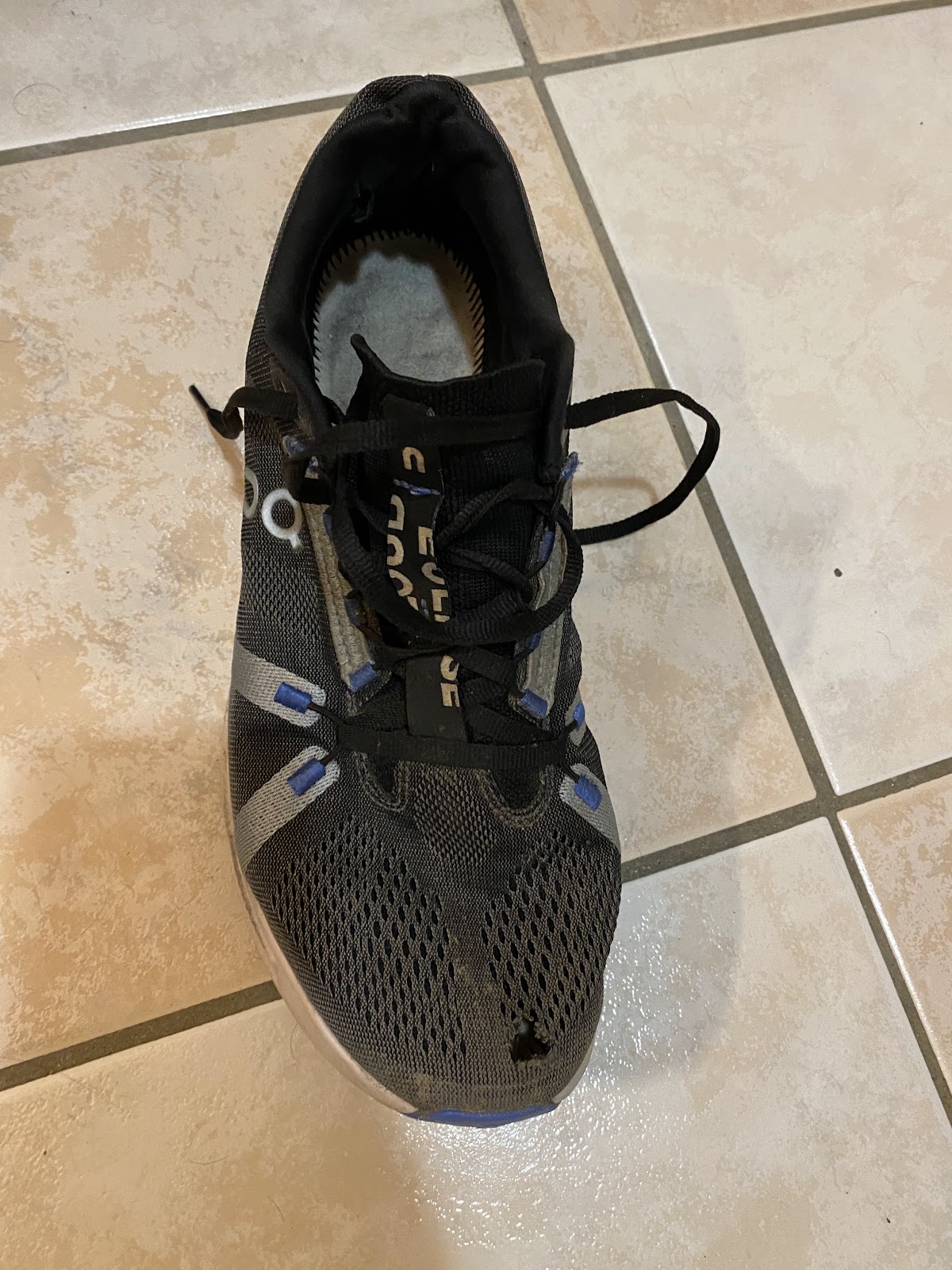
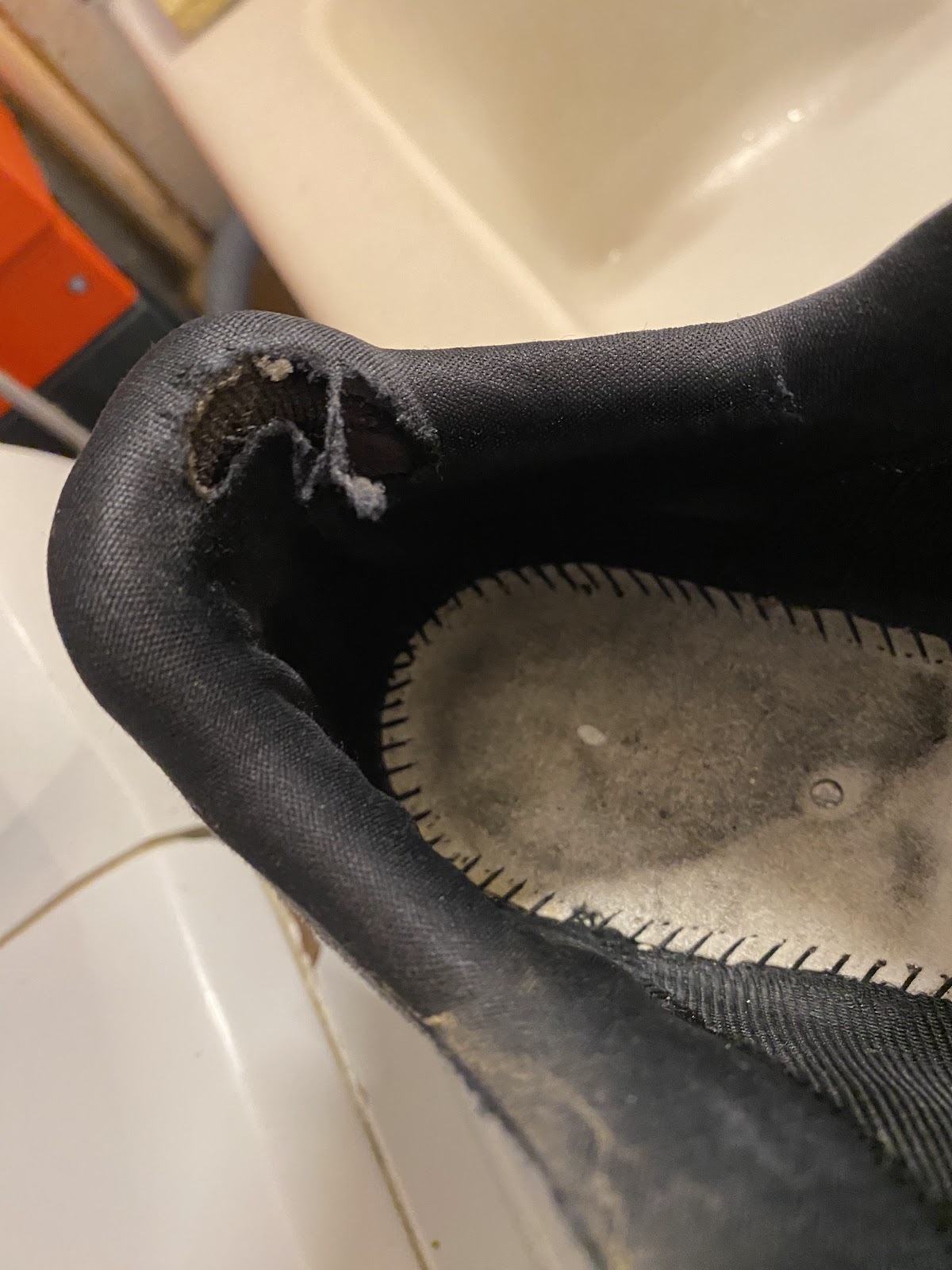
  • Après 61 activités de course, dont le marathon de Chicago et Marseille-Cassis, soit un total de 827 km, je vais arrêter d'utiliser ces chaussures. 
  • La chaussure droite a désormais un trou sur le dessus et à l'avant de la chaussure :
    Trou sur le devant de la chaussure


  • La chaussure gauche est détériorée sur la partie arrière :
Arrière de la chaussure


  • En somme, je suis déçu par ces chaussures et j'ai recommandé des Hoka Clifton 9

lundi, avril 29, 2024

Marathon du Conemara - Marathon #22

  •  Le 21 avril 2024 j'ai fait le full marathon du Conemara. Le temps était étonnant pour la saison : du soleil et une température très agréable de 13 à 17 degrés. Les paysages sont merveilleux et les 548 participants, avec parmi eux Michel et moi-même, se sont vraiment fait plaisir sur ce parcours. 
  • C'est un parcours dans la nature à contrario de la plupart des marathons que j'ai effectué jusqu'à présent, majoritairement en ville.
  • Que du bonheur et de bons souvenirs sur ce marathon au profil particulièrement dur :
  • Les résultats : 4h 10 pour faire le marathon, semi-marathon parcouru en 1h 54 minutes. 178 sur 548 et 5ème sur 23 dans la catégorie des plus de 60 ans.
  • J'ai parcouru le marathon km après km au niveau du mental.
  • La dernière montée, dénommée "hell of the West", je l'ai grimpée tout en force et courage sans un seul arrêt.


dimanche, mars 03, 2024

Semi-marathon de Bourg-en-Bresse


  • Le résultat du semi-marathon de Bourg-en-Bresse couru sous la pluie. Deux courses partent simultanément, le 10 et le 21 km. Pour le 21 km c'est deux tours de circuit, le premier tour il y a beaucoup plus de monde et ça court plus vite.
  • Je suis très satisfait du temps réalisé et j'ai pas vu passé les 4 derniers kms ou j'ai poussé mon effort et doublé beaucoup de concurrents.
  • Les temps à chaque km :

jeudi, février 22, 2024

The Science of Running - Steve Magness


  • lampoon: ridiculiser
  • marred: gâché
  • tenets: principes
  • overarching: global
  • boulder: rocher
  • calf: mollet
  • hamstring: ischio-jambier
  • to stagger: échelonner
  • depletion: épuisement 
  • buildup: accumulation
  • revved up: vombrir
  • curtail: écourter
  • priming: amorçage
  • to summon up: mobiliser
  • to ingrain: instiller
  • bout: poussée
  • culprit: coupable
  • to garner: recueillir
  • to ascribe: imputer
  • ludicrous: ridicule
  • credence: croyance
  • prominence: importance
  • crapshoot: coup de poker
  • nemesis : ennemi juré
  • clearance: évacuation
  • ankle: cheville
  • recoil: recul
  • heel: talon
  • stride: foulée
  • scoot: filer
  • to paw: gratter
  • namesake: homonyme
  • to impart: transmettre
  • carbohydrate: glucide
  • stardom: célébrité
  • imprinting: empreinte
  • spurt: jaillissement
  • trendiness: coté branché 
  • happenstance: hasard
  • eagerness: enthousiasme
  • overlooked: oublié
  • to forgo: renoncer
  • makeup: composition
  • bout : periode
  • to thrive off: prospérer
  • efficacy: efficacité
  • repletion: satiété
  • depleted: réduit
  • dumbed down: nivelé par le bas
  • unwiedly: encombrant
  • overarching: global
  • soreness: douleur
  • strenuous: fatigant
  • to bolster: soutenir
  • carbohydrate: glucide
  • to eke out: faire durer
  • conundrum: casse-tête
  • tug of war: tire à la corde
  • overly: trop
  • buildup: accumulation
  • to rev up: faire vombrir
  • level off: se stabiliser
  • duress: contrainte
  • gait: démarche
  • shuffling: traînant
  • to entail : impliquer
  • strain: tirer de toutes ses forces
  • belabor: s'éterniser
  • grinder: broyer
  • revved up: faire vombrir le moteur
  • slogging: trimer
  • bounding: rebondissement

Introduction

  • A method that uses hill sprints and strength endurance circuits to teach the runner to recruit more muscles and then extend their endurance.
  • The great Hungarian coach Mihaly Igloi used his knowledge of muscle fibers to theorize that if runners changed their stride patterns from what he called a short swing to a long swing pattern, they would switch the muscle recruitment pattern and thus be able to delay fatigue slightly.
  • Remember not to just follow the crowd for the sake of change.
  • The goal of training is to build on top of what has been done previously.
  • Balancing speed and endurance is the key to proper training.

    Section 1: The Science of Distance Running

    1 - How running Happens

    • You are trying to compensate for fatigue by a variety of biomechanical adjustments.
    • Running is a skill that needs to be learned and refined.
    • Stored ATP: Adenosine TriPosphate = molécule riche en énergie.
    • Increasing the capacity of the aerobic system to produce energy is a beneficial training adaptation to delay fatigue.

    2 - Fatigue: Friend or Foe?

    • FT: Fast Twitch muscle fiber
    • ST: Slow Twitch muscle fiber
    • Muscle or tendon damage is one way that the storage and use of elastic energy can decrease.
    • Elastic energy is called "free energy".
    • The three basic energy systems are the immediate (Phosphagen and Myokinase), Glycolysis, and Aerobic system. Each system requires a series of chemical reactions that ultimately result in ATP (Adénosine Tri Phosphate) reformation.

    3 - The Brain: The Master Controller

    • Fatigue is a brain-derived emotion.
    • Homeostasis: phénomène par lequel un facteur clé (par exemple la température) est maintenu autour d'une valeur bénéfique pour le système.
    • Fatigue was a result of a desire to maintain homeostasis.
    • In the classic marathon example, pace slows before a runner truly runs out of glycogen.
    • The brain is the master controller.
    • Neurotransmitters serotonin and dopamine.
    • Serotonin is popularly known as the chemical in the brain that is associated with depression.
    • Dopamine is a chemical that's most well-known role is in the reward pathway.
    • Rating of Perceived Exertion (effort physique) (RPE)
    • As we get closer to the finish line, it's easier to pick up the speed because the danger is decreased.
    • It is the mismatch between our expected feelings versus our actual feelings that governs performance.
    • How we feel is a result of physical and psychological effort.

    4 - An Oxygen Problem?

    • VO2max refers to the maximum amount of oxygen used and is calculated by taking the amount of oxygen taken in and subtracting the oxygen exhaled out.
    • Pulse oximeter: this device simply clip on your finger and take the oxygen saturation in the blood in a noninvasive way.
    • The takeaway message should be don't focus your training on improving some parameter like VO2max, instead focus on providing the right training stimulus to improve race performance.

    5 - The Fallacy of VO2max

    • "If you are a scientist and believe in truth, you've got to say you don't know when you don't know. There's is always a temptation, especially if you have a theory, to try to prove it rather than to find out what is the truth." Frederick Singer
    • It is almost as if it is human nature to go through this process of discovery and then exaggeration of the importance of the new finding.
    • Whenever something is new, it is overemphasized.
    • VO2max reflects this regulation of muscles recruitment.
    • VO2max does not improve in well-trained individuals.
    • VO2max and endurance performance are used almost synonymously, which is not true.
    • After four weeks of training using an interval program designed to elicit time at VO2max, VO2max and, more importantly, performance did not improve.
    • The change in VO2max did not correlate with the change in performance on a time trial.
    • It probably makes more sense to standardize paces in relation to their recent race performances.
    • The logic is that if VO2max is increased, endurance performance increases. This is not the case.
    • VO2max does not correlate well with performance and cannot be used to distinguish which runners are faster.

    6 - Lactate, Acid and Other By-Products

    • "Our almost unlimited ability to ignore our ignorance." Daniel Kahneman
    • Lactate Threshold (LT) is defined as the fastest running speed at which blood lactate levels remain in a relative steady state.
    • Les mitocondries sont le lieu de la production la plus importante d'Adénosine TriPhosphate (ATP), le "carburant" énergétique des cellules.
    • In addition the heart, brain, and liver all play an active role in clearing lactate from the blood.
    • Contrary to popular belief, lactate does not cause fatigue. In fact, lactate is a fuel source and likely delays fatigue.
    • Lactate produced inn a muscle fiber can be used as a fuel source by several organs.
    • 4x1mile w/ 3 min rest
    • 3 sets of 4x400m w/ 45 sec rest at 3k pace, 3 mins between sets
    • In order to increase energy available we can increase the Anaerobic Capacity.
    • The takeaway message is that lactate levels reflect a balance of opposing aerobic and anaerobic forces.

    7 - Efficiency

    • "The search for understanding, wherever it roams, is a search for better simplifications. Simplifications which explain more and distort less...All human understanding is based on simplifications of more complex realities." Bill James
    • Running Economy (RE)
    • A stiffer muscle is more efficient during running than a flexible one.
    • It was found that the Achilles tendon stores 35% if its kinetic energy, while tendons that are in the arch of the foot store 17%.
    • Rapid movements such as sprinting or plyometrics will train the tendons to be better able to utilize the energy.
    • Sprinting is about the most specific form of plyometric activity that can be done for runners, yet it is often underutilized. Doing 60-100m accelerations is a great way to work on elastic energy.
    • Runners are more efficient at running velocities at which they frequently train.
    • Heel striking might be a sort of protective mechanism when we are venturing too far away from homeostasis.
    • Swinging your arms gives you an energy saving effect of around 4% compared to not swinging your arms.
    • The interesting part was that the 10mm cushioning "saved" more energy than the 20mm cushioning.
    • Running is a skill, just like hitting a baseball or swinging a golf club.
    • Slow Twitch (ST) fibers being better equipped to utilize oxygen due to its increased mitochondria, myoglobin, and Krebs cycle enzymes.
    • How much oxygen is needed by the muscles, the efficiency in delivering and utilizing that oxygen, and how well substrates can be utilized all play a role.
    • The preferred fuel of source in endurance races that last less than a couple of hours is glycogen. The body has a finite supply of glycogen stored in the muscles, while it has a relatively large supply of fat. Due to limited glycogen stores, in longer distance races, such as a marathon, glycogen depletion is a major source of fatigue.
    • Long runs and high mileage training tend to increase the total glycogen supply of the muscles.
    • Training in a fasted state is one way to increase the use of fat as a fuel. Therefore, for a marathon runner, some runs and long runs should be done without taking supplemental fuel, as low glycogen during the run seems to be the signal for a shift in substrate use.
    • A marathoner who is able to utilize fats more will spare his glycogen stores, delaying fatigue.
    • His goal is to run as fast as he can while using glycogen at a rate that will put him depleted just after the finish line.

    8 - The Brain-Muscle Connection

    • "The subjective experience of pain is constructed from both our physiological state and contextual data...when nerve cells send a signal to the pain centers of your brain, your experience of pain can vary even if those signals don't." Leonard Mlodinov
    • Distance runners need large amounts of training, or damage, to complete this muscle fiber conversion.
    • Training increase fiber recruitment during hard training may be one way to combat this problem of fatigue.
    • Strength endurance work.
    • This idea could explain why heavy resistance training or sprinting improves distance running performance, as it increases the total muscle fiber pool that can be recruited.
    • EMG= electro diagnostique
    • At higher temperatures more of the blood is redistributed to the skin to aid in cooling.
    • An acclimatized person can sweat up to 4 liters per hour; while a person not acclimatized can only sweat about 1,5 liters per hour.
    • Recent research has suggested that drinking ice-cold fluids helps to combat the core body temperature.
    • Racing is a very intense activity. Dealing with pain or mental toughness is often cited as a reason for success in the sport distance running.
    • What motivates elite Kenyan runners is economic incentive, followed by talent and distraction.

    9 - The Genetics of Training

    • "Our ability to spot patterns is what allows us to make sense of the world, but sometimes, in our eagerness, we are oversensitive and trigger-happy and mistakenly spot patterns where none exist." Ben Goldacre
    • In order for the workout to elicit adaptation, it has to be significant enough both in terms of intensity and volume to disturb the body's homeostasis.
    • Two examples of this process are a high intensity endurance workout at altitude might decrease the oxygen saturation levels, while a lengthy endurance workout might result in a depletion of glycogen.
    • A larger stimulus is required to disturb homeostasis.
    • If the marathon is an event that is dependent on the optimal fuel use ratio between carbohydrates and fats, how do we signal the body to change that ratio so that there is more reliance on fat. We need to "embarrass" it and send the signal that more fat needs to be used. How do you do that? Simple, by running a workout that depletes the glycogen stores to a significant enough amount that the body adapts to make sure that it does not run low on glycogen the next time. It accomplishes this by increasing the use of fat as a fuel and/or increasing glycogen stores.
    • The idea is to train low, compete high, or, in other words, do some training in a low glycogen state, while competing fully stocked with glycogen.
    • That explains why runners in particular need a wide variety of training stimuli.
    • EPO: hormone qui stimule la fabrication des globules rouges.
    • hypoxic: inadéquation entre les besoins tissulaires en oxygène et les apports.
    • RBC: Red Blood Cell

    10 - Theories of Training Adaptation

    • "It is not the strongest or the most intelligent who will survive but those who can best manage change." Charles Darwin
    • General Adaptation Syndrome (G.A.S)
    • "Fight or flight"
    • Assigning the correct intensity and volume of a workout to elect an optimal response is essential in proper training.
    • The change in VO2max did not correlate with the change in performance on a time trial, which is a significant finding demonstrating that perhaps more attention should be paid to changing performance instead of manipulating physiological parameters such as VO2max.
    • In practical terms for trained distance runners, it probably makes more sense to standardize paces in relation their recent race performances or based on percentages of goal race pace in well-trained runners.

    11 - Volume and Intensity of Training

    • East African runners averaged 172 km per week.
    • High volume approach.
    • Several higher intensity workouts per week, which are separated with easier runs.
    • Faster training could have an impact on the traditional factors in performance: V02max, LT (Lactate Threshold), and RE (Running Efficiency).
    • It was the amount of easy running that impacted running performance over a 10km race not the amount of high intensity training.
    • Low volume training is optimal.
    • This approach where high volume training must precede high intensity training is fundamental in popular literature on distance running, but it is neglected in the research.
    • The idea that a base moderate work needs to be established before intense training is done in order to achieve maximum benefits.
    • A long block of high intensity training leading to decreased performance, mostly likely due to overtraining.
    • In distance running, it is accepted that well-trained runners train every day or at least six days out of the week.
    • Elite Kenyan runners trained between 10-14 times per week.
    • Some researchers have suggested that training in a fatigued state may enhance subsequent adaptations.
    • It has been found that training in a glycogen depleted state enhances gene transcription of several markers of training adaptation.
    • Recommendations in the popular literature suggest that 2-3 intense workouts should be done per week.

    12 - Periodization of Training

    • Periodization is the process of dividing the training into smaller periods of training where the emphasis, or the target, of the training is altered during each period.
    • The mesocycle consists of several weeks of training.
    • It is generally accepted that harder days are followed by one or two easier days before another hard day is repeated.
    • After 16 weeks of training the periodized cyclists performed significantly better in a time trial.
    • The traditional approach consisted of very high volumes of work early in the season that consistently lowers as the season progresses with a proportionate increase in intensity.
    • 3 blocks of 4 weeks each.
    • Started with a several month period called Marathon Conditioning where high volumes (100mpw) of easy to moderate running were done. Following this phase, mileage was decreased and the intensity was increased with a one month period called Hill Resistance which focused on strength endurance by using a variety of hill repeats and hill circuits. The next phase consisted of track training, starting with longer intervals on the track (800's, miles) and progressively working towards shorter intervals (200's and 400's). This was followed by a sharpening and peaking phase that consisted of shorter faster work, such as 50m in and out sprints or an all out 200m,, and a further drop in volume.


    • Essentially, the workouts start at the extreme and work towards each other, like a funnel:


    13 - Where Do We Go From Here?

    • Perhaps this shift in thinking will get us away from the propensity for relying almost solely on VO2max as a measure of endurance when it is only one factor, has exploded due to its ease of measurement, and does not even change in elite runners.
    • It is tough to give advice on training to improve performance when the exact mechanisms that limit performance are not known.
    • Training does not occur in isolation. Instead, a global and integrated approach to training should be taken.

    Section 2 How to Train

    • "We don't have the time or the mental bandwidth to observe and consider each detail of every item in our environment. Instead we employ a few salient traits that we observe to assign the object to a category, and then we base our assessment of the object on the category rather that the object itself." Leonard Mlodinov

    14 - The Philosophy of Training

    • "It is much easier, as well as far more enjoyable, to identify and label the mistakes of others than to recognize our own. Questioning what we believe and want is difficult at the best of times, and especially difficult when we most need to." Daniel Kahneman
    • "Oversimplifications can be in science; they can cut through the hideous complexity with a working model that is almost right, postponing the messy details until later."
    • It seems simplistic but the adaptation that we get from any training method is a result of whatever stimulus was applied. In other words, our body adapts to the stimulus it is given and in the direction that the stimulus is applied.
    • What a coach needs to know:
      • What adaptations are needed for your individual athlete training for an event
      • Timing - At what period and how often should the athlete be working on these adaptations.
      • How much stimulus (volume, intensity, density, etc...) needs to be applied for your individual athlete
      • How much recovery and what type of training can be done while the athlete adapts.
    • Obviously each event requires different demands, whether it is in terms of aerobic versus anaerobic contribution, tactics, psychology, or mechanical demands.
    • It should be obvious that the amount of stress that a workout causes should be in proportion to how much recovery is needed following that workout.
    • So if we gon on a 38km run, we expect to be heavily glycogen depleted.
    • In running we are keenly aware of the physical stress, but we need to realize that psychological or emotional stress also contributes to the total stress load.
    • The best way to monitor recovery is not by some top-secret scientific gadget, but instead by simply listening to your body. It is a skill to understand the feedback that your body is providing.
    • The first way is to perform workouts in a pre-fatigued state. Instead of being completely fresh for all hard workouts if we start them in a slightly depleted state, we can now delve deeper into the depths of glycogen depletion and access muscle fibers we seldom recruit.
    • The last amplifier that influences the training stress part of the equation is manipulating fuel to shift adaptations.
    • The best way to do this is either via fasted runs or longer runs with no supplemental fuel.
    • Consider running some with only water.
    • The obvious one is recovery nutrition. We all have been inundated with information about taking carbohydrates or protein after a workout, so I won't cover that in detail, except to say that it works and that protein is showing to be more important not only fro the muscle repair but also for tendon growth.
    • Taking five hits of 20g of protein throughout the day will keep protein synthesis elevated throughout the day. Additionally, taking a large dose of protein before bed will keep protein synthesis elevated during sleep, which is when large portion of recovery and repair takes place.
    • Research has shown that testosterone levels rise during the first REM (Rapid Eye Movement) = sommeil paradoxal qui est la dernière phase du cycle de sommeil = c'est à ce stade que nous rêvons le plus.
    • If our body senses a lot of inflammation, it brings in the heavy-duty repair equipment to shore up the defenses and build it stronger.
    • Oxidation occurs during running and acts as one of the major triggers for increasing mitochondria to deal with all of those pro-oxidants. If all of a sudden we take an artificial anti-oxidant, then we again have a 3rd party that acts as a cleaning crew and shuts down the signal that the body needs to majorly adapt. What is interesting is that, according to research, only artificial antioxidants vitamins seem to have this strong effect. Natural antioxidants coming from fruits do not cause this effect.
    • The concept of train low, compete high in regards of the carbohydrate intake. There is a growing body of evidence that shows training in a low glycogen state activates signaling pathways that influence both aerobic gains and fuel efficiency.
    • Altitude should be thought of as another stressor, just like heat, humidity, or including a hill in a run.
    • The reduction of psychological stress may play a role in their success.
    • The major key concepts to keep in mind when considering balance are speed, endurance, strength, and power.
    • mTOR : contrôleur central de la croissance cellulaire en réponse aux facteurs de croissance et aux nutriments
    • Speed and endurance play opposing roles.
    • There's a reason why the base phase, which traditionally includes a lot of general endurance training, is done in early in the season. And regardless of your beliefs, we generally follow a base phase with something more intensive and more speed oriented.
    • It's about knowing how to balance the development of speed and endurance and knowing when each needs to be at their highest in the season.
    • It's important to know what we need to know, what questions we need to ask, and what we do about it.


    15 - What Are We Trying to Accomplish?

    • "When faced with a difficult question, we often answer an easier one instead, usually without noticing the substitution." Daniel Kahneman.
    • His point was that most of the time endurance was the key to performance.
    • Decrease in blood glucose is believed to play a role in fatigue.
    • We need to do workouts that cause a large increase in muscle fiber recruitment such as sprints, hill sprints, or heavy weights lifting.
    • Another option is to do long uphill repeats as more muscle fibers are recruited during uphill running than flat running.
    • Marathon: the main cause of fatigue is the depletion of fuel.
    • "A Scientific approach to the Marathon" Renato Canova.
    • The ultimate goal training is to race a particular distance at a certain pace.
    • Steady refers to a pace that is generally 5-10% slower than marathon pace, or, in other terms, it's a good consistent pace that requires some focus to run but is not tiring. Easy refers to paces that are up to around 25/30% slower than marathon pace. Easy refers to paces that are up to around 25-30% slower than marathon pace.
    • The bottom line is that not only do runners need to have an endurance foundation off which to build, but they also need a speed foundation.
    • Start backwards. Work the extremes. Bring it together. Never leave anything behind. Progress everything.

    16 - Creating and Manipulating Workouts

    • We have to challenge homeostasis. So, we have to delve a little deeper into the depths of glycogen depletion to get the body to respond and make us utilize glycogen a little more efficiently. Or if we are improving strength, we need to have just enough micro-tears so that the body responds with repairing and making the muscle stronger. Essentially, we need to embarrass the body just enough so that it decides it is more prepared next time it faces this challenge.
    • I'am a big believer in very gradually increasing the stimulus of the workout.
    • The problem with training to complete exhaustion is that it is very hard on the nervous system, the endocrine system, the immune system, and psychologically.
    • Working too hard or not being challenged enough can lead to the same result, apathy.
    The optimal challenge window 
    • The goal is to embrace the freedom and creativity of being able to design workouts to work with you as a runner.
    • The "Typical" List:
      • Rep distance
      • Total volume
      • Rest between intervals
      • Speed
    • If we are able to increase speed, we improve in the direction of speed; if we handle longer reps, we increase our ability to endure.
    • By negative splitting, we are working on recruiting more fibers as we go along and gradually ramping up the stress, as well as ingraining a positive psychological mindset towards finishing fast.
    • We know physiologically that when we change out of a rhythm, it takes the body a little time to adjust the breathing, heart rate, etc... to the new level.
    • Having much longer recovery between sets than we would between reps.
    • 3 sets of 3x800 with 90 sec rest with 5 min between sets towards 9x800m with 90 sec rest by the end of the season.
    • If we shorten the recovery, the aerobic demands of the workout actually increase.
    • In standing rest, our oxygen consumption and heart rate would drop.
    • We could insert strength work such as squats, lunges, or squat jumps into the recovery to work on strength endurance.
    • When we switch a workout to include hills, it increases the strength component of the workout and slightly changes the muscle fiber recruitment.
    • As a general rule, the degree of incline can almost be taught of in terms of the light weight versus heavy weight lifting paradigm.
    • Running on a variety of surfaces.
    • Take away the sets to increase the stress of the workout:
      • 3 sets of (4x400 with 60 sec rest) 3 min rest between sets
      • 2 sets of (6x400) with same rest
      • 12x400 with 60/70 sec rest
    • Density is essentially a combination of work done and the time taken to do that work.
    • The surrounding density of the training can greatly affect the stress and subsequent adaptations.
    • Instead of fully recovering, we may use minimal recovery devices so that we create the pre-fatigue state. In fact, during the base and pre-competition phases of training, recovery is de-emphasized for this exact reason.
    • We want to shift fuel metabolism and the way to do this is to "embarrass" the system. So we need to delve deeper into the depths of glycogen depletion. To do this, we could do fasted runs where we wake up and don't fuel before a run so that we use our overnight fast as a way to train with less glycogen. Similarly, we may do really long runs without fueling support to push the stress of low glycogen further. We can use nutrition to manipulate the stressor of the workout.
    • We have to train the mental aspect during practice.
    • We see workouts as a way to increase stress and drive adaptation. The way that stress is increased determines the direction of the adaptation the body takes. Therefore, it's a simple act of stress that leads to adaptation.

    17 - Individualizing Training

    • For example, if someone was using a strict Lydiard system, he would try to get the athlete up to 100mpw, then follow it with hills, and so forth.
    • The key to true individualization is creating the training system around the individual runner's needs.
    • They should be able to use a high mileage approach when that is needed and a low mileage/high intensity approach when that is needed.
    • The best coach adapts to the individual giving him exactly what he needs.

    mercredi, février 21, 2024

    HoKa Clifton 9


    • Clap de fin pour les chaussures Puma Nitro que j'ai utilisées pendant 796 km.
    • Première paire de Hoka, modèle Clifton 9 que j'ai pu avoir grace à un bon d'achat offert par Annie et Michel.
    • Drop de 5 mm (moins 3 mm par rapport à la Puma Nitro)
    • Taille 44 2/3
    • 240 g

    lundi, novembre 20, 2023

    Le 21 ème marathon : Beaujolais

    •  Ca y est c'est fait, j'ai terminé mon 21 ème marathon, le 6 ème du Beaujolais. Un temps assez froid au départ (5 à 6 degrés) qui s'est surtout ressenti sur les 3/4 du marathon. Un départ pris assez rapidement car le profil descendant se prête bien pour une allure rapide. Passage merveilleux à Pizay et Saint Ennemond et après je me force un peu à ralentir l'allure. Passage à Cercié au 17 ème km en 1 heure 28 minutes et au km 21 à Charentay en 1:53. Je suis très content de ces temps de passage. J'atteins le km 30 en 2h47, ce qui me rassure car mon objectif était d'atteindre les 30 kms en moins de 3 heures.
    Chateau de Pizay


    • Le marathon commence alors et je me fixe de finir sans s'arrêter une seule fois jusqu'au 35 ème km, km après km. Et ça passe malgré des douleurs dans les deux quadriceps. Ces douleurs persistent tout le long de la descente vers Villefranche.
    Rue Nationale


    • Enfin j'arrive à Villefranche et je finis en ayant le sentiment d'avoir juste commencé la course : je n'ai pas vu passer le temps malgré les douleurs. Je suis très content de mon temps : 4h14' soit seulement 6 minutes de plus que ce même marathon il y a 18 ans.
    Arrivée
    • Les résultats :
    Les résultats du marathon du Beaujolais 2023


    dimanche, novembre 12, 2023

    21 ème marathon - 6ème marathon du Beaujolais

    • Dans moins d'une semaine ce sera mon 21 ème marathon et le 6 ème marathon du Beaujolais. En terme d'entraînement, cela fait 15 semaines d'entraînement depuis début août :
      • 690 km de course à pied en 51 sorties
      • 1982 km de vélo en 43 sorties

    • Durant 4 semaines j'ai limité la distance à 30 km de course à pied par semaine à cause du tendon d'Achille gauche. J'ai effectué des soins par mésothérapie qui m'ont permis après ces 4 semaines d'augmenter à nouveau le kilométrage.
    • La rencontre avec le médecin du sport m'a permis d'une part de guérir le tendon d' achille. 
      • A son contact j'ai aussi progressé dans les étirements. 3 fois 30 secondes pour respectivement les tendons d' Achille, les ischio-jambiers et les quadriceps.
      • Le docteur m'a convaincu du rôle du vélo dans la préparation de la course à pied. On verra le résultat pour le marathon :=)
      • Conseil du médecin : si une douleur apparait en courant, cela peut être une contracture. Il faut alors s'arrêter et faire des étirements. Si cela persiste, alors il faut réduire la séance.
      • Normalement en cas de blessure, c'est six semaines d'arrêt.
    • Les nouvelles semelles orthopédiques ainsi que les conseils de l'orthopédiste sur la spécificité des exercices du tendon d' Achille ont contribué aussi à la guérison. 
    • J'ai aussi réussi à collecter des fonds pour SDS :


    mardi, septembre 26, 2023

    PUMA Nitro

    • Clap de fin pour les chaussures ASIC Gel Nimbus que j'ai utilisées pendant 743 km.
    • Début d'une nouvelle paire PUMA Nitro :

    • Le protocole conseillé par la podologue consiste à courir 3 semaines avec les semelles orthopédiques afin de voir s'il est nécessaire d'adapter les semelles orthopédiques.
    • Il est important de continuer à faire les exercices d'étirement des tendons.
    • Garder les semelles orthopédiques même après la course.
    • Drop de 8 mm